ACT Practice Questions: Effective Strategies and Key Examples Explained
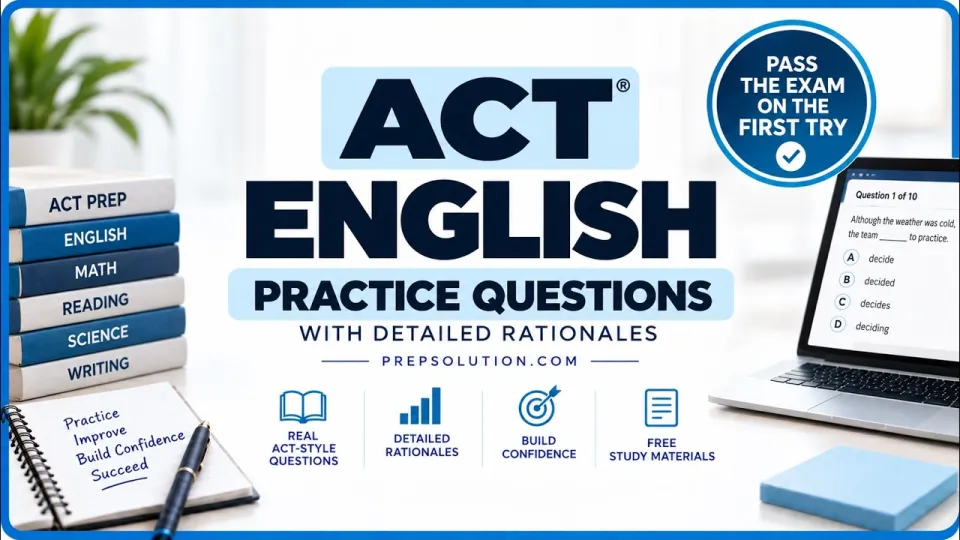
Video: ACT Practice Questions | 10 English Questions Explained
Key takeaways
- Includes 10 explained ACT English questions from PrepSolution
- Focus on grammar, punctuation, sentence structure, and clarity
- Learn when to select 'No Change' as the correct answer
- Covers essential ACT English rules and test strategies
- Free access to a complete ACT prep system via PrepSolution
ACT practice questions are essential for improving your English section score by familiarizing you with common grammar, punctuation, sentence structure, and transition challenges on the test. By working through 10 carefully explained ACT English questions, you can identify typical mistakes and understand why the correct answers are best, helping you build confidence and accuracy. For additional resources and a complete prep system, visit PrepSolution's ACT Complete Prep System.
Understanding ACT English Practice Questions
ACT English practice questions focus heavily on grammar, punctuation, sentence structure, and clarity. Each question tests your ability to spot errors and improve writing while maintaining the original meaning. Key components include:
- Grammar and Agreement: Recognize the true subject of a sentence to select correct pronouns and verb forms. Decide when comparative forms like "better" or superlatives like "best" are appropriate.
- Punctuation: Identify and correct comma splices, proper apostrophe placement, and the correct use of colons, especially distinguishing when a colon should follow a complete sentence.
- Sentence Structure: Ensure lists are parallel and modifiers are placed correctly next to the words they describe to avoid ambiguity.
- Clear and Concise Writing: Eliminate redundant words without changing the sentence's meaning for more direct communication.
- Transitions: Choose the best transitional words or phrases by understanding how ideas connect logically within and between sentences.
These areas are repeatedly tested, making practice questions an effective way to internalize rules and recognize common traps.
Common Grammar Challenges in ACT English
Mastering grammar is critical for success. Typical grammar questions require you to:
- Determine the real subject to ensure subject-verb agreement.
- Select the right pronoun case (e.g., "who" vs. "whom").
- Decide between comparative and superlative forms correctly.
For example, a question may present sentences with different pronouns or verb agreements and ask which is correct. Understanding these rules helps avoid costly mistakes.
Punctuation Rules Tested in ACT English
Punctuation questions often focus on:
- Fixing comma splices: Avoid joining two independent clauses with only a comma.
- Proper apostrophe use: Distinguish possessive forms from plurals.
- Correct colon placement: A colon should follow a complete sentence introducing a list or explanation.
Recognizing these rules allows you to quickly identify errors and choose the best punctuation.
Improving Sentence Structure and Clarity
Questions may ask you to make sentences clearer and more concise by:
- Keeping items in a list parallel in structure.
- Placing modifiers next to the words they modify to prevent confusion.
- Removing redundant or wordy phrases without losing meaning.
This ensures your writing is both grammatically correct and easy to read.
Using Transitions to Connect Ideas
Transitions help clarify relationships between ideas. ACT questions may require choosing the best transition word or phrase based on:
- Whether the sentence introduces contrast, addition, cause and effect, or sequence.
- The logical flow of ideas within the passage.
Recognizing the purpose of the transition ensures coherence.
When to Choose "No Change"
Sometimes the best answer is to leave the original sentence unchanged. This is true when:
- The sentence already follows all grammar, punctuation, and style rules.
- No clarity or conciseness improvements are needed.
Knowing when "No Change" is correct prevents unnecessary corrections.
Useful Tips for ACT English Practice
- Read each question carefully and identify what rule it tests.
- Eliminate obviously wrong answers first.
- Verify subject-verb agreement and pronoun correctness.
- Check punctuation marks closely, especially commas and colons.
- Confirm sentence clarity and parallel structure.
- Consider if the transition word fits the logic.
- Remember that sometimes the original sentence is best.
Helpful Resources
- PrepSolution's ACT Complete Prep System offers extensive practice questions and detailed explanations to deepen your understanding.
Conclusion
Working through ACT practice questions, especially those that explain each answer, is a powerful way to improve your English score. By mastering grammar, punctuation, sentence structure, and transitions, you can confidently tackle the ACT English section. The channel PrepSolution provides clear, step-by-step walkthroughs of typical questions and offers a complete prep system to help you prepare effectively. For free resources and to register, visit their official ACT prep page.
Questions & answers
What types of questions are included in ACT English practice questions?
ACT English practice questions cover grammar, punctuation, sentence structure, clarity, and transitions to test your ability to improve writing and maintain meaning.
How can I decide when to choose 'No Change' in ACT English questions?
You should select 'No Change' when the original sentence follows all grammar and punctuation rules correctly and is clear and concise without unnecessary words.
Why is understanding punctuation important for ACT English?
Proper punctuation, like fixing comma splices and correct colon placement, ensures the sentence is clear and grammatically correct, which is crucial for the ACT English section.
Where can I find more detailed explanations and practice for ACT English?
PrepSolution offers a complete ACT prep system with detailed explanations and practice questions accessible at https://prepsolution.com/exam/act?utm_source=youtube&utm_medium=video&utm_campaign=act_longform&utm_content=act_longform_v02.
Source: ACT Practice Questions | 10 English Questions Explained · Markdown version